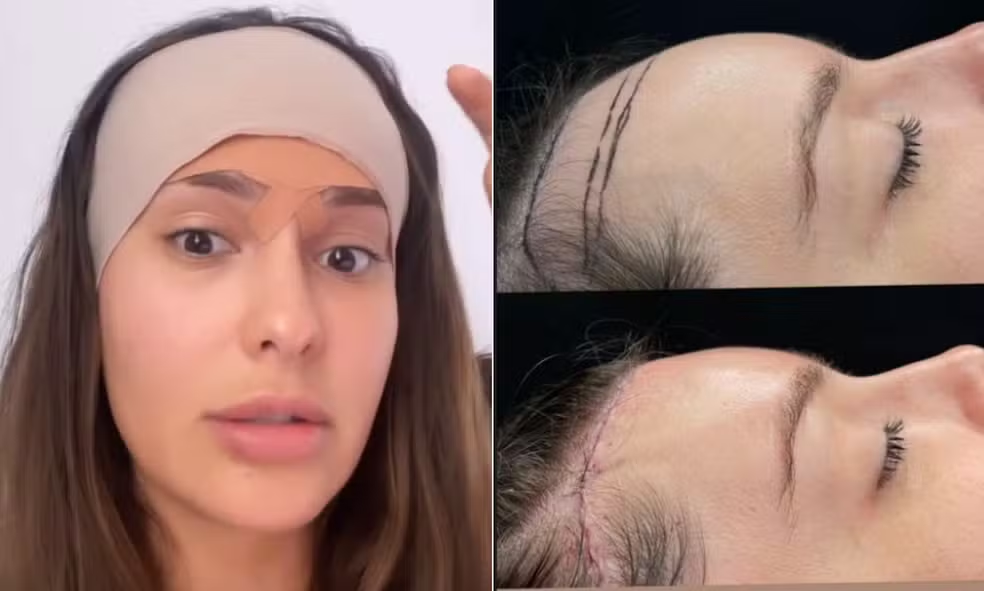
Brow lift surgery is appropriate only when brow position—not upper-eyelid skin alone—is contributing to heaviness or altered expression. The decision depends on brow shape, frontalis activity, hairline, forehead height, eyelid function, previous Botox and the amount of tissue laxity.
Is the problem the brow, the eyelid or both?
A descended brow can crowd the upper eyelid. Some patients compensate by contracting the frontalis throughout the day, creating forehead lines and temporarily raising the brow. Recent botulinum toxin may reduce this compensation and change the examination. Other patients have true upper-eyelid skin excess, levator ptosis, or both.
Removing eyelid skin without assessing the brow can leave heaviness untreated. Elevating the brow when the eyelid is the main problem can change expression without solving the functional concern.
| Finding | What confirms it | Selected option |
|---|---|---|
| Brow descent | Resting position, asymmetry, frontalis compensation | Video-assisted or selected open brow surgery |
| Upper-eyelid skin excess | Skin fold with acceptable brow position | Conservative upper blepharoplasty |
| True eyelid ptosis | Low lid margin and levator assessment | Ptosis correction |
| Temporal heaviness | Lateral brow and temple descent | Individualized lateral or video-assisted treatment |
| Volume loss | Superior sulcus hollowing | Selected microfat, not additional skin removal |
How Dr. June plans video-assisted brow surgery
At Belvivere, video assistance is used for selected upper-face and midface indications through small scalp access points. Magnification supports controlled release and visualization of relevant anatomy. The tissues are repositioned in a vector chosen for the patient’s brow shape, forehead and hairline, then fixed to stable structures.
The aim is not to raise the entire brow to a fixed height. Excessive central or lateral elevation can create surprise, change the eye–brow relationship or exaggerate pre-existing asymmetry. Dr. June’s planning emphasizes preservation of the patient’s recognizable expression and selective release rather than maximal elevation.
Long-term morphometric research has found maintained brow elevation after both endoscopic and pretrichial open approaches, without proving one universally superior. The study was retrospective and included 65 patients, so it supports durability in selected cases rather than a guarantee for an individual patient.
When an open approach may be discussed
Hairline position, forehead height, previous scars, hair density and the amount of skin laxity influence incision planning. A pretrichial or other open approach may offer direct control in selected anatomy, but it places a scar at or near the hairline and can affect sensation or hair growth. A video-assisted approach uses shorter scalp incisions but is not scarless and does not automatically suit a high hairline or substantial laxity.
When eyelid surgery belongs in the plan
When brow descent and eyelid changes coexist, brow surgery may be combined with selected Hybrid Blepharoplasty components. Upper-eyelid skin removal remains conservative. Orbicularis preservation, ocular-surface assessment and recognition of true ptosis help protect function and avoid an operated or hollow appearance.
Lower-eyelid bags, lid laxity, tear-trough hollowing, malar edema and festoons require separate diagnosis. Brow elevation does not correct these findings.
Botox and fillers can alter the examination
Botulinum toxin may temporarily lower or reshape the brow by reducing frontalis activity. The product, dose, sites and treatment date should be documented. Forehead or temple fillers, biostimulators, threads and permanent materials can change the tissue planes. Dermatologic ultrasound may help identify residual material when the history is incomplete or the examination is unclear.
Risks and recovery
Bruising and swelling may extend around the eyes. Forehead or scalp numbness, itching, tightness, headache, tenderness and discomfort with chewing can occur. Specific risks include hematoma, infection, visible or widened scars, hair thinning around an incision, fixation problems, asymmetry, undercorrection, overcorrection and sensory or motor nerve changes.
Patients may look presentable before brow position, sensation and scars have stabilized. The tissues continue to settle over several months. Surgery cannot guarantee symmetry or stop future aging.
Planning from outside Brazil
A remote consultation can organize records and a preliminary plan. The final decision follows in-person examination, including brow movement, eyelid position and ocular symptoms. Major combined surgery is performed at Hospital São José. The concierge service supports travel logistics, while the clinical team manages recovery and flight clearance.
Questions to ask before choosing a brow lift
- Is the heaviness caused by brow descent, eyelid skin or ptosis?
- How will the planned vector affect my existing brow shape?
- Where will the scars sit relative to my hairline?
- Could recent Botox be changing the examination?
- Should eyelid surgery be combined, staged or avoided?