Coronal lift vs. endoscopic brow lift comparisons represent a major decision point for individuals seeking to correct a heavy, drooping brow line and forehead wrinkles. As the upper third of the face ages, tissue laxity can lead to sagging eyebrows, prominent frown lines, and a constantly tired or stern facial expression. To restore a youthful, refreshed look, plastic surgeons utilize different surgical approaches to elevate the forehead tissues. Understanding the specific structural differences between a coronal lift vs. endoscopic brow lift allows patients to make informed choices that align with their hairline position, anatomical goals, and preferred recovery timeline.
If you are exploring advanced options for facial rejuvenation, choosing a highly qualified surgical team is the most important step. To learn more about modern standard coordination and global medical consultation, you can visit Belvivere. Their commitment to individualized surgical care ensures that your facial structure is evaluated with precision.
The Evolution of Forehead Rejuvenation Techniques
To understand the debate surrounding a coronal lift vs. endoscopic brow lift, one must look at how facial plastic surgery has evolved over the past few decades. Historically, modifying the upper face required extensive incisions to manually reposition tissue and muscle.
[Traditional Coronal Lift] -> Ear-to-Ear Incision -> Maximum Tissue Removal & Lift
|
[Modern Endoscopic Lift] -> Small Portal Incisions -> Camera-Guided Tissue Repositioning
|
[Anatomical Outcome] -> Preserved Sensation, Hidden Scars, Rapid Recovery
The older, traditional method involves a continuous incision running across the top of the scalp, whereas the modern minimally invasive alternative uses fiber-optic cameras and specialized micro-instruments. Weighing a coronal lift vs. endoscopic brow lift means balancing the sheer lifting power of open surgery against the rapid healing and hidden incisions of endoscopic technology.
The Traditional Open Coronal Lift
The open coronal approach is the classic technique upon which modern brow surgery was built. During this procedure, the surgeon makes an incision starting from above one ear, traveling across the top of the head behind the hairline, and ending above the opposite ear.
Direct Visualization: The open incision allows the surgical team to directly see the underlying frontalis muscles, corrugator muscles, and orbital rims.
Skin Excision: Excess scalp skin is physically trimmed away before closing, which provides a dramatic and highly reliable lift for severe cases of tissue sagging.
The Modern Endoscopic Alternative
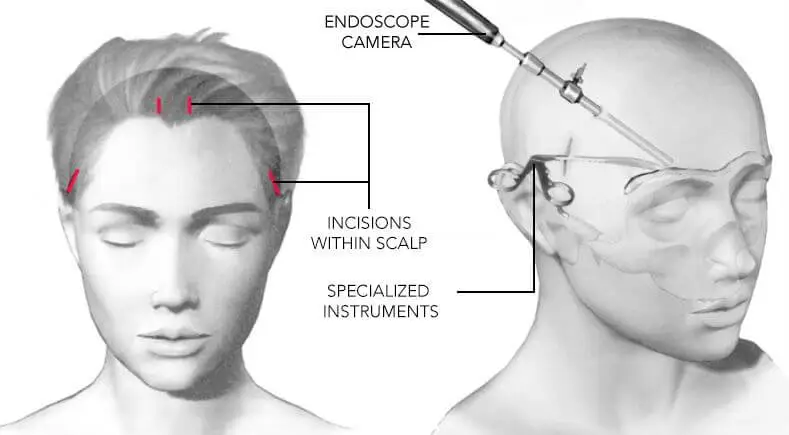
In contrast, the endoscopic brow lift represents a major technological leap forward. Instead of a single long incision, the surgeon creates three to five small, vertical portal incisions, each measuring less than an inch, hidden entirely within the hair.
A small tube with a light and a high-definition camera (an endoscope) is inserted through these openings. This transmits a magnified view of the internal structures to a monitor, allowing the surgeon to release tight ligaments and lift the forehead tissue cleanly without removing any scalp skin. This stark difference in tissue handling is a central point when analyzing a coronal lift vs. endoscopic brow lift.
Architectural Distortions: Impact on Hairline and Anatomy
Evaluating Hairline Changes: Coronal Lift vs. Endoscopic Brow Lift
A critical factor when choosing between a coronal lift vs. endoscopic brow lift is the patient’s existing hairline height and forehead proportions. Because the traditional coronal technique removes a strip of scalp tissue behind the hairline, it pulls the hair backward, effectively lengthening the forehead.
If a patient already has a high forehead or a receding hairline, a coronal incision will make the forehead look excessively large, creating an unbalanced appearance. Conversely, when comparing a coronal lift vs. endoscopic brow lift, the endoscopic approach shifts the entire forehead and scalp unit backward slightly but does not lengthen the forehead to the same degree, making it a much more versatile choice for individuals concerned about their hairline position.
For patients who wish to combine advanced structural facial surgeries with meticulous planning, exploring premier medical destinations is an excellent choice. You can learn about top-tier medical protocols by researching options for Plastic Surgery in Brazil, a country globally celebrated for its pioneering advancements, artistic mastery, and highly rigorous safety standards in aesthetic medicine.
Essential Components of Surgical Customization
Technical Nuances: Coronal Lift vs. Endoscopic Brow Lift Execution
Determining which approach is ideal requires a careful analysis of the patient’s underlying bone structure, muscle hyperactivity, and tissue density. The table below highlights the practical differences encountered during clinical execution:
| Feature Category | Traditional Coronal Lift | Endoscopic Brow Lift |
| Incision Size | Single, continuous ear-to-ear incision | 3 to 5 small, vertical portal incisions |
| Hairline Impact | Raises the hairline and lengthens forehead | Minimal, balanced shifting of the hairline |
| Scalp Sensation | Temporary or permanent numbness likely | Minimal disruption to sensory nerves |
| Fixation Method | Permanent structural skin excision | Temporary endotines, bone tunnels, or sutures |
Nerve Preservation and Scalp Sensation
A major point of discussion in the coronal lift vs. endoscopic brow lift comparison is the impact on sensory nerves. The coronal incision crosses the paths of the supraorbital nerves, which supply sensation to the top and back of the scalp.
Cutting through these pathways causes prolonged, and sometimes permanent, numbness behind the incision line. In the coronal lift vs. endoscopic brow lift debate, the endoscopic method scores much higher for patient comfort, as the camera allows the surgeon to visualize and carefully protect these delicate nerves, minimizing post-operative numbness.
Tissue Fixation and Longevity
Because the endoscopic method does not trim away excess skin, it relies on advanced fixation methods to hold the lifted forehead tissues in place while they heal to the bone in their new position. Surgeons utilize temporary, bioabsorbable devices called Endotines, or create micro-tunnels in the bone to secure the tissues with sutures.
When evaluating a coronal lift vs. endoscopic brow lift for long-term durability, the coronal lift has a historical reputation for lasting slightly longer in patients with heavy, thick skin due to the physical removal of tissue, though modern endoscopic fixation has closed this gap significantly.
Selecting a Specialist Aligned with Advanced Facial Architecture
The technical success of your upper facial rejuvenation depends entirely on your surgeon’s commitment to individual planning. A patient should seek a board-certified specialist who recognizes that shortcuts during the planning phase lead to unnatural, surprised-looking results.
During your consultation, be entirely transparent about your past cosmetic history, your hair styling habits, and your family history of hair loss. A thorough specialist will inspect your periorbital area and explain why comparing a coronal lift vs. endoscopic brow lift is essential for the harmony of your face. To see real-world examples of how this meticulous preparation leads to beautifully balanced transformations, Check out the results of some patients.
The Recovery Journey and Post-Operative Management
The healing process varies greatly between a coronal lift vs. endoscopic brow lift. Because the coronal approach involves a long incision and significant tissue alteration, patients often experience more pronounced swelling, bruising, and discomfort across the forehead and around the eyes.
Coronal Recovery: Requires careful wound care along the extensive hairline incision, with staples or sutures removed around two weeks post-op.
Endoscopic Recovery: Involves less deep tissue trauma, leading to less swelling. Most patients can return to public life and light activities within a week to ten days.
Long-Term Protection: Regardless of the technique chosen, avoiding heavy lifting and protecting the forehead from direct sun exposure for several months is crucial to ensure optimal scar healing and tissue stability.
Conclusion: Balancing Efficiency and Invasiveness
Ultimately, the choice between a coronal lift vs. endoscopic brow lift comes down to your unique anatomy and tolerance for downtime. The traditional coronal lift remains a powerful tool for individuals with severe tissue laxity and a low hairline who require maximum skin removal.
However, for the vast majority of modern patients, the endoscopic brow lift offers an ideal combination of minimal scarring, nerve preservation, and natural-looking rejuvenation. By partnering with an expert surgical team that carefully evaluates your facial structure, you can select the precise technique that will reveal a refreshed, youthful appearance that stands the test of time.