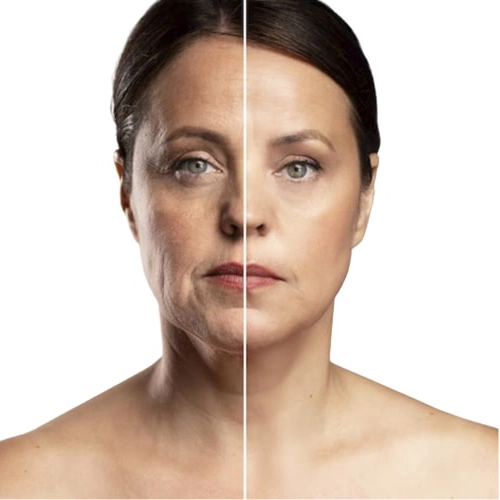
Facelift surgery treats descent of selected lower-face tissues; it does not correct every sign of facial aging. Jowls and loss of jawline definition may improve when the SMAS and related retaining structures are repositioned. Brow descent, eyelid changes, cervical fullness, volume loss and skin damage require their own diagnoses.
What a facelift can—and cannot—change
A facelift can reposition mobile lower-face tissues and reduce reliance on skin tension. The amount of improvement depends on tissue quality, ligament laxity, skeletal support, previous surgery and the chosen extent of dissection. It cannot erase pores or pigmentation, restore all lost volume, correct true eyelid ptosis, or change the position of the hyoid bone.
| Concern | Primary structure | Possible treatment |
|---|---|---|
| Jowls | SMAS, ligaments, fat compartments, bone support | Selected SMAS or Deep Plane facelift |
| Low brow or midface | Brow position, temporal tissues, malar descent | Video-assisted surgery in selected anatomy |
| Eyelid bags or hollowing | Fat compartments, lid support, skin, volume | Selected Hybrid Blepharoplasty components |
| Platysma bands or neck laxity | Skin, fat, platysma, deeper structures | Neck Lift or selected Deep Neck |
| Fine lines and pigment | Epidermis and dermis | Dermatologic treatment after appropriate healing |
How the surgical plane is selected
SMAS plication or imbrication
These approaches tighten or reshape the superficial musculoaponeurotic system without the same extent of deep release used in a Deep Plane operation. They may be appropriate when mobility, tissue quality, previous surgery or the required correction supports a more limited plan.
Deep Plane facelift
Deep Plane surgery releases selected retaining ligaments and mobilizes a composite layer in the lower face. It can be useful when tissue descent and mobility justify deeper repositioning. The operation runs near facial nerve branches and demands precise anatomical dissection. It should not be presented as a universal gold standard.
Limited-incision and hybrid plans
Shorter scars may suit selected patients with less skin excess. They do not mean less internal surgery and may offer inadequate skin control when laxity is substantial. In some anatomy, video-assisted midface surgery can complement lower-face work, but the procedures treat different regions.
Current comparative evidence remains limited. A 2025 meta-analysis found broadly comparable safety profiles for SMAS and deep techniques, but only one included study directly compared aesthetic outcomes. Technique choice therefore remains a clinical decision rather than a ranking exercise.
Why the neck is assessed separately
The lower face and neck are related but not interchangeable. Cervical contour may be affected by superficial fat, platysma bands, skin laxity, subplatysmal fat, digastric muscles, submandibular glands, mandibular projection and hyoid position. A Neck Lift commonly combines central platysma repair with lateral support. Deep Neck work is added only when deeper anatomy contributes enough to justify its additional risk.
Volume loss is not tissue descent
Microfat may restore selected compartments when volume loss contributes to hollowing. Nanofat has superficial indications and does not provide structural projection. Adding volume to descended or edematous tissue can increase heaviness. Repositioning and grafting can be combined, but neither should be used to compensate for a missed diagnosis.
Previous injectables belong in the surgical history
Fillers, biostimulators, threads, PMMA, silicone and energy treatments can affect planes, inflammation and edema. Product names, dates, sites and complications should be disclosed. Dermatologic ultrasound may help map residual material. Hyaluronidase can act on hyaluronic acid but does not reverse permanent fillers, biostimulators or transferred fat.
Candidacy includes medical risk and recovery capacity
The assessment covers blood pressure, bleeding and thrombosis history, nicotine exposure, nutrition, sleep apnea, weight stability and medications including GLP-1 drugs. A safe plan may require treatment of a medical condition, a smaller operation, staging, postponement or declining surgery.
A large prospective database study of 11,300 facelift patients found that risk varied with patient and procedural factors. Such data help structure assessment; they do not predict one individual’s outcome or replace anesthetic evaluation.
Risks and the recovery timeline
Risks include hematoma, infection, delayed healing, skin compromise, visible scars, hairline change, sensory or motor nerve injury, contour irregularity, salivary complications and revision. Blood-pressure control, treatment of pain and nausea, and structured observation are part of hematoma prevention.
Bruising, swelling, tightness, numbness and temporary asymmetry are expected to varying degrees. Social recovery often precedes biological recovery. Scars, sensation and internal swelling continue to mature for months. Review the facelift recovery timeline and warning signs after surgery.
Facelift care for international patients
The preliminary plan can begin remotely, but candidacy and surgical scope are confirmed in person. Major surgery is performed at Hospital São José. International patients generally plan at least 15 days in Brazil, adjusted to the operation and recovery. The concierge team manages practical arrangements; the medical team controls discharge, postoperative treatment and flight clearance.