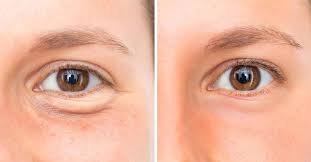
Upper, lower and Hybrid Blepharoplasty treat different combinations of skin, fat, support, volume and eye function. The correct operation begins by distinguishing eyelid disease from brow descent, true ptosis, midface position, edema, festoons and pigment.
Upper blepharoplasty treats measured skin excess
Upper-eyelid heaviness can arise from skin excess, a low brow, frontalis compensation, true ptosis or A-frame hollowing. Removing more skin does not correct every cause and may produce a deep sulcus or incomplete closure.
Dr. June’s preservation-based approach removes only measured skin excess and preserves the orbicularis muscle. Brow position and eyelid-margin height are assessed separately. Mild selected ptosis may require a functional procedure; video-assisted brow surgery may be considered when brow descent is the dominant problem.
Lower blepharoplasty treats bags without emptying the orbit
Lower-eyelid bags reflect prominence of the medial, central or lateral fat compartments. Dr. June uses a transconjunctival bi-incisional route to access the three compartments through two internal incisions. Fat may be preserved, selectively adjusted or repositioned according to anatomy.
Festoons and malar edema are not ordinary eyelid bags. Pigmentation, visible vessels and skin texture also require separate evaluation. Removing orbital fat cannot correct all under-eye darkness.
Hybrid Blepharoplasty coordinates the complete periorbital diagnosis
| Finding | Possible component | Limit |
|---|---|---|
| Upper skin excess | Conservative upper blepharoplasty | Does not elevate the brow |
| Lower bags | Transconjunctival compartment treatment | Does not treat festoons or pigment |
| Lower-lid support | Cantopexy | Must preserve canthal shape and closure |
| A-frame or lid–cheek hollow | Conservative microfat | Retention varies; excess can look heavy |
| Selected superficial concern | Nanofat, CO2 laser, microneedling or another skin treatment | Does not create structural lift |
| Brow or midface descent | Selected video-assisted surgery | Not required for an isolated eyelid problem |
Cantopexy supports lower-lid position
Cantopexy with durable absorbable fixation is routinely incorporated into Dr. June’s Hybrid Blepharoplasty protocol. The tension and vector remain individualized. Support should protect lower-lid position without rounding the eye or creating an artificial upward slant.
Previous filler can change both diagnosis and recovery
Hyaluronic-acid filler in the tear trough or malar region may persist, attract water and contribute to chronic edema. Biostimulators, threads, PMMA, silicone and energy devices can also alter tissue. At Belvivere, dermatologic ultrasound is required when prior injectables may affect surgical planning. Hyaluronidase acts only on hyaluronic acid.
Eye health must be assessed before aesthetic goals
Evaluation includes dry eye, tearing, contact lenses, previous ocular surgery, thyroid disease, glaucoma, allergies, blink, closure, lid tone and asymmetry. Ophthalmologic review may be required.
Risks include bleeding, infection, chemosis, persistent dryness, lagophthalmos, lower-lid retraction or ectropion, asymmetry, diplopia, graft irregularity and rare visual loss. Sudden severe pain, rapidly increasing swelling or visual change is an emergency.
Recovery depends on the components selected
Swelling often worsens during the first 48 hours and then begins to stabilize. Many patients become more socially comfortable during the following days, but edema, scars, sensation and fat-graft integration evolve for weeks to months. Brow, midface or skin procedures extend recovery.
International patients complete in-person confirmation before surgery and remain for postoperative review. The Concierge supports logistics; clinical progress determines flight clearance. Read the guide to blepharoplasty swelling and warning signs.