Endoscopic Brow Lift: Indications, Risks and Recovery
An endoscopic brow lift—also called video-assisted brow surgery—uses small scalp incisions and a camera to release and reposition selected upper-face tissues. The aim is not to create a fashionable “foxy eye” or raise every eyebrow. It is to correct brow descent or asymmetry in a way that respects the patient’s forehead, eyelids, hairline and natural expression.
Is the heaviness caused by the eyelid or the eyebrow?
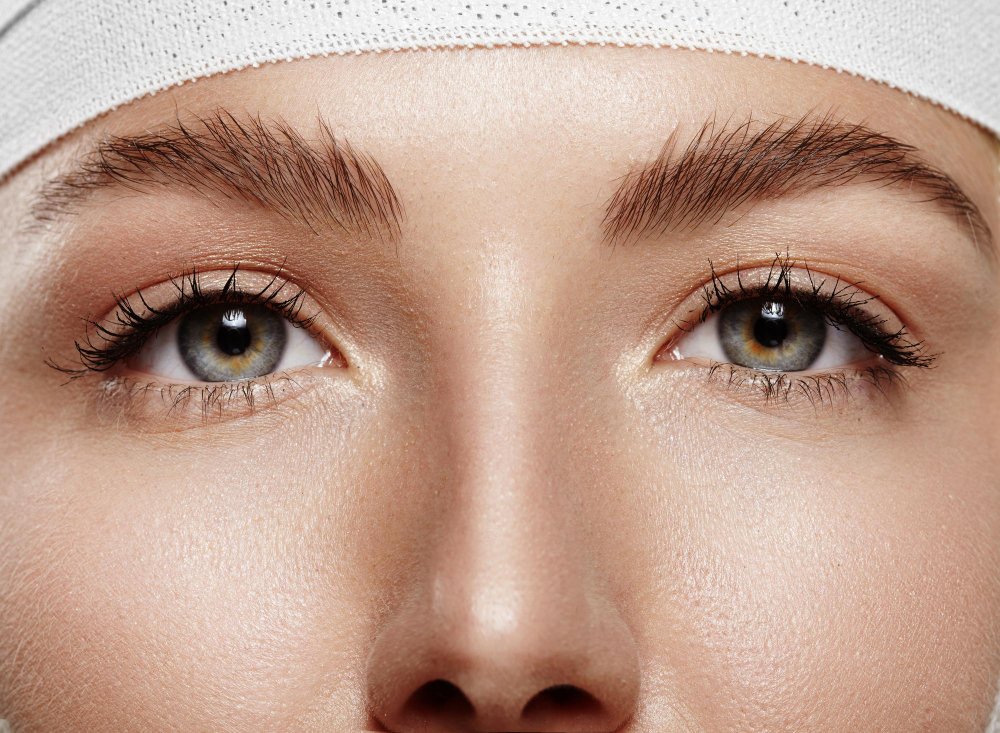
Upper-eyelid skin and eyebrow position must be assessed together. A low brow can crowd the upper eyelid and lead a patient to believe that blepharoplasty alone is needed. Removing too much eyelid skin without recognizing brow descent can produce an incomplete result and limit safe future elevation.
Conversely, not every heavy eyelid requires brow surgery. Some patients benefit from conservative upper blepharoplasty alone, while others need a combined plan. Read about when eyelid surgery may not be enough.
How video-assisted brow surgery is performed
Through small incisions within the scalp, the endoscope provides magnified visualization of the surgical plane. Dr. June Favarin’s approach may use five access points. The frontal dissection is generally subperiosteal, with release around the temporal crest and lateral zygomatic-temporal attachments when the midface is included.
The tissues are repositioned according to individualized vectors and fixed at selected points. Temporal fixation may use the deep temporal fascia; frontal fixation may use a bone tunnel or a small titanium screw. Treatment of the corrugator and procerus muscles in the glabellar area is conservative because expression and nerve safety matter.
Brow refinement rather than a standardized lift
The ideal brow position is not the same for every face. The surgeon evaluates hairline height, forehead length, brow shape, orbital anatomy, asymmetry, muscle activity and previous surgery. Excessive elevation can produce surprise, distort identity or lengthen an already high forehead.
Video assistance improves visualization, but it does not make the procedure risk-free, scarless or automatically preferable to other techniques. Direct, temporal or hairline approaches may be more suitable in selected patients. “Minimally invasive” describes incision strategy; it does not mean minimal surgery internally.
Previous Botox, fillers and threads
Botulinum toxin can temporarily change brow position and muscle recruitment. Fillers, biostimulators, threads and energy devices may alter tissue planes. Patients should provide dates, products and treated areas. Dermatologic ultrasound may be required when previous materials are suspected, and the surgical plan may change after imaging.
Scars, risks and recovery
Scalp incisions are designed to be concealed by hair, but no scar is invisible. Possible complications include bleeding, infection, delayed healing, visible or widened scars, hair loss around incisions, asymmetry, over- or under-correction, persistent pain, numbness, itching and the need for revision. Temporary weakness from neuropraxia can occur; permanent nerve injury is uncommon but possible.
Swelling and bruising may extend around the forehead, temples and eyelids. Tightness and altered scalp sensation are expected early. Scalp sutures are commonly removed around day 15. Numbness or tingling can take three to four months—or occasionally longer—to improve. Social recovery varies, and final brow position settles gradually.
International-patient planning
| Planning Milestone | Typical Timing |
|---|---|
| Scalp sutures removed | ~Day 15 |
| Numbness/tingling improvement | 3–4 months (sometimes longer) |
| Arrival before surgery | 1–2 days prior |
| Minimum stay in Brazil | At least 15 days |
Assessment can begin by video with standardized photographs, but final indication requires in-person examination. International patients generally arrive in Criciúma one or two days before surgery and remain at least 15 days. Surgery is performed in a hospital, with postoperative reviews before flight clearance.
The concierge team assists with accommodations and local coordination. Clinical restrictions take priority over sightseeing. Learn more about Hybrid Blepharoplasty and video-assisted midface surgery.