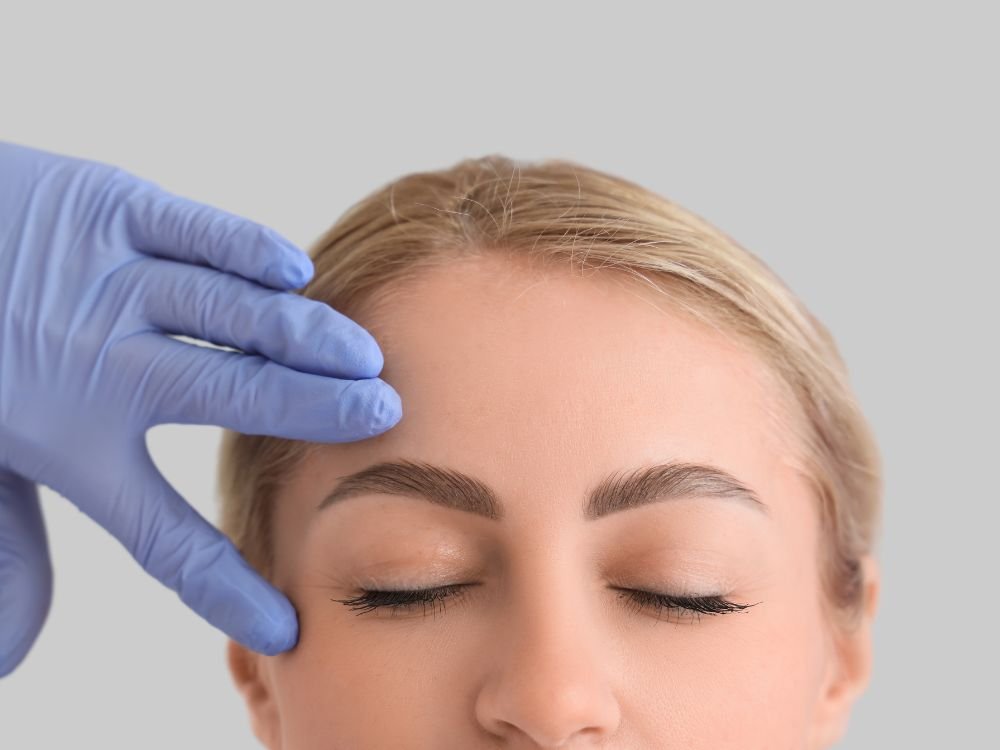
Traveling to Brazil for Hybrid Blepharoplasty requires a plan for diagnosis, eye safety and postoperative review—not only a surgical date. Remote consultation can begin the process, but Dr. June Favarin confirms the procedure after examining the brow, eyelids, eye surface, lid support, facial volume and previous treatments in person.
Before booking travel
- Send standardized photographs with the forehead relaxed and during eyebrow elevation.
- Report dry eye, contact-lens intolerance, difficulty closing the eyes and all previous ocular operations.
- List Botox, fillers, biostimulators, threads, PMMA, silicone and energy treatments, including approximate dates.
- Do not stop medications or dissolve filler without individualized medical guidance.
- Plan for an accompanying adult and flexible return travel.
What Hybrid Blepharoplasty may include
| Finding | Possible component | Important limitation |
|---|---|---|
| Measured upper-eyelid skin excess | Conservative skin removal with orbicularis preservation | Does not correct a low brow or true ptosis |
| Selected mild ptosis | Conjunctivo-Müller correction | Requires functional assessment |
| Lower-eyelid bags | Transconjunctival bi-incisional access to three fat compartments | Does not treat pigmentation or festoons |
| Lower-lid laxity | Selective canthopexy | Not required for every patient |
| Periorbital hollowing | Small-volume microfat | Retention varies; excess volume can look heavy |
| Selected skin-quality concerns | Nanofat or dermatologic treatment | Does not replace structural correction |
Hybrid Blepharoplasty is therefore a decision framework, not a package. Treating every component can increase dryness, swelling, scarring and the risk of an overtreated appearance.
Why the eyebrow and eye surface matter
A heavy upper eyelid may result from brow descent, frontalis compensation, true ptosis, volume loss or skin excess. The examination also considers blink, tear symptoms, lower-lid tone and canthal support. Ophthalmologic assessment may be required after cataract, refractive or other eye surgery, or when symptoms suggest ocular-surface disease.
Previous filler and dermatologic ultrasound
Under-eye filler can persist, attract water or obscure the lid–cheek transition. When the product, plane or tissue reaction is uncertain, dermatologic ultrasound may support the plan. Hyaluronidase acts only on hyaluronic acid and is not automatically required. Read the decision guide on dissolving filler before eyelid surgery.
Recovery and warning signs
Swelling commonly becomes more noticeable during the first days. Bruising, tearing, dryness, temporary blurred vision from ointment and early asymmetry may occur. Risks include bleeding, infection, chemosis, lagophthalmos, lid malposition, persistent dryness, diplopia, fat-graft irregularity and rare visual injury.
Sudden pain, rapidly increasing one-sided swelling or any visual change requires emergency assessment. Social readiness does not mean complete healing; residual edema and scars evolve for months.
Travel pathway in Brazil
- Arrival: in-person examination and confirmation of the plan.
- Surgery: performed at Hospital São José when appropriate to its extent.
- Early recovery: scheduled examinations, instructions and an accompanying adult.
- Return home: only after medical assessment and flight clearance.
The concierge team helps with accommodation and local logistics but does not replace medical observation. The necessary stay is individualized and may be longer when brow, midface or facelift procedures are combined.