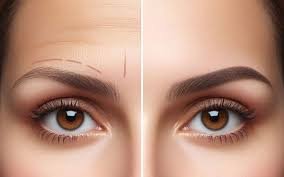
Upper-eyelid heaviness does not identify the operation. It may come from measured skin excess, brow descent, true eyelid ptosis, loss of orbital volume or a combination. Blepharoplasty treats the eyelid; brow surgery repositions selected upper-face tissues. The correct plan depends on which structure is responsible when the forehead is relaxed.
Four findings change the decision
| Dominant finding | Possible direction | What requires caution |
|---|---|---|
| Measured upper-eyelid skin excess | Conservative upper blepharoplasty | Over-resection when the brow is low |
| Brow descent with frontalis compensation | Observation or selected brow surgery | Removing eyelid skin without addressing position |
| True eyelid ptosis | Selected ptosis correction | Assuming skin removal will raise the lid margin |
| Combined brow and eyelid change | Combined or staged treatment | Adding procedures without a separate indication |
The forehead must be examined at rest and in motion
The frontalis muscle often elevates a low brow to clear the visual axis. This compensation can create forehead lines and make the resting brow appear higher than it is. Examination should compare the relaxed face with brow elevation, eye closure and natural expression.
Recent botulinum toxin can reduce frontalis activity and change the apparent amount of eyelid skin. The injection pattern and date therefore matter. A manual brow lift in the mirror may show that the regions are connected, but it cannot determine the surgical vector or the amount of skin that can be removed safely.
What conservative upper blepharoplasty can treat
Upper blepharoplasty may help when skin excess independently rests on the lid or interferes with makeup or vision. Dr. June Favarin favors measured skin treatment and preservation of functional orbicularis when possible. The purpose is to maintain closure, expression and orbital volume rather than create the same crease or exposure in every face.
Randomized trials comparing orbicularis-sparing and orbicularis-excising techniques did not show a consistent long-term difference in most dry-eye measurements. These studies do not make muscle removal necessary or prove that preservation alone prevents symptoms. Eye-surface history, closure, scleral show and the extent of surgery still influence risk.
When video-assisted brow surgery enters the plan
Video-assisted surgery may be considered when the brow position contributes materially to upper-eyelid heaviness. Through four or five small scalp portals, selected attachments around the orbital rim and temporal region are released and the tissues are fixed in an individualized vector. Small incisions do not mean a limited internal dissection.
Position should be refined, not standardized
Forehead length, hairline, brow shape, asymmetry and frontalis behavior affect the approach. Objective studies show that endoscopic brow elevation is usually modest and can remain measurable for years; they do not establish an ideal height for every patient. The tail may behave differently from the central brow, and open or direct approaches may suit other anatomies.
True ptosis and hollowing require separate decisions
When the eyelid margin is low, levator function and the response to clinical testing guide whether ptosis repair is appropriate. Removing more skin does not correct muscle dysfunction. Conversely, an A-frame hollow can make the upper lid look skeletal even without significant skin excess. Conservative microfat may be discussed for selected volume loss, but it does not lift the brow or correct ptosis.
Risks and recovery differ between procedures
Blepharoplasty can cause dryness, chemosis, incomplete closure, asymmetry, scarring, bleeding, infection, lid malposition, diplopia and rare visual injury. Brow surgery adds scalp numbness, incision-related hair loss, fixation irregularity and temporary or persistent weakness involving facial-nerve branches.
Forehead swelling can descend into the eyelids. Bruising and social recovery often improve before sensation, position and scars have settled. Sudden visual change, severe pain or rapidly increasing one-sided swelling requires emergency assessment.
Planning from abroad
Remote photographs can begin screening, but the final choice follows in-person brow, eyelid and ocular examination. Surgery is performed at Hospital São José when appropriate to the operative plan. The Belvivere Concierge assists with accommodation and transport; medical reviews and flight clearance remain clinical decisions.
Related reading: video-assisted brow-lift planning and Hybrid Blepharoplasty anatomy and preservation.
Clinical sources
- Endoscopic brow-lift morphology and longevity: five-year objective study
- Endoscopic brow lift with upper blepharoplasty: measured postoperative position
- Orbicularis preservation and tear-film outcomes: randomized trial
This article is educational and does not replace individualized medical or ophthalmologic evaluation.