Why Removing Old Fillers Before a Blepharoplasty or Face Lift Is Essential for a Safe Recovery
It is becoming increasingly common to see patients who wish to undergo blepharoplasty, face lift, or other facial surgeries but still have old fillers in their tissues — often products injected many years ago and long forgotten. These materials, especially when permanent, semi-permanent, or of unknown origin, can significantly affect both the surgical outcome and the healing process.
When old filler residues remain in the face, the postoperative recovery becomes slower, with more swelling, increased bruising, and a higher risk of inflammatory complications. For this reason, removing these products before surgery is a crucial step.
The role of ultrasound in surgical planning
Today, the recommended method to assess and remove old fillers is dermatologic ultrasound. This technology allows us to identify:
- The exact location of the material
- Its depth
- The approximate volume
- High-risk regions such as the malar area, temples, and tear trough
Once mapped, the filler is removed with ultrasound-guided precision, ensuring safety and accuracy.
Only after all visible product is removed on ultrasound can the patient experience a smoother, more predictable healing process with fewer inflammatory reactions.
Why ultrasound is indispensable
Many fillers remain in the tissues for years, even when patients believe they were fully absorbed. Over time, these products can leave:
- Encapsulated residues
- Chronically inflamed fragments
- Material that has degraded or changed chemically
After removal, the tissues return to a more stable, healthier environment, without chronic inflammatory stimuli. This directly improves recovery after blepharoplasty or face lift surgery.
The risk of very old or unknown fillers
As time passes, some fillers — especially non-standardized or permanent ones — undergo chemical changes, forming irregular cross-links that make the tissue stiffer, more fibrotic, and more reactive. This explains why some patients develop:
- Persistent swelling
- Inflamed nodules
- Thickened or firm tissue
- A sensation of heaviness in the face
Additionally, many old fillers are highly hydrophilic, meaning they attract water. This increases swelling, distorts volume, and heightens the risk of postoperative complications.
Inflammation and the danger of biofilm
Another critical concern is the potential for chronic inflammation or even biofilm — a low-grade bacterial contamination that can persist silently for years. Biofilm can be reactivated during surgery, creating significant complications.
Biofilm may cause:
- Recurring redness
- Sensitivity
- Nodules
- Prolonged inflammatory reactions
For these reasons, removing old filler before any facial surgery is not just recommended — it is essential for safety.
High-risk areas: special attention to the periocular region
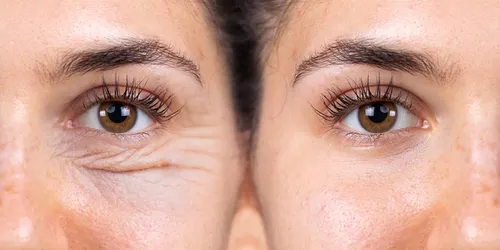
Old filler in the tear trough or other areas near the eyes is particularly problematic. The skin here is thin, delicate, and highly vascularized, leading to:
- Excessive fluid retention
- Pronounced swelling
- Persistent discoloration
- Extended inflammation
By thoroughly removing all product detected on ultrasound, we greatly reduce the risk of complications and ensure surgery is performed on healthy, stable tissue.
Conclusion
Before performing a blepharoplasty, face lift, or any facial surgery, it is essential to evaluate and remove old fillers, even if the patient believes they have already disappeared. Dermatologic ultrasound makes this process precise, safe, and highly effective.
Once old material is removed, the postoperative recovery becomes lighter, with less swelling, fewer risks, and much more predictable, long-lasting results.