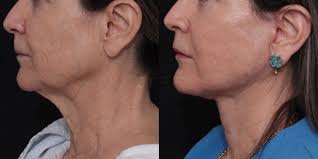
Face Lift: When Swelling Persists and How to Treat Residual Neck Volume
A face lift is one of the most sought-after procedures for facial rejuvenation and for redefining the neck contour. However, even when performed with proper technique, some patients may develop prolonged swelling or small residual bulges in the submandibular region. Understanding why this happens and what can be done to correct it is essential for anyone seeking a truly harmonious result.
This article explains, in a clear and objective way, the main causes of persistent neck fullness after a face lift, how to identify when something is outside the expected healing pattern, and which complementary procedures may be indicated.
How long is swelling normal after a face lift?
Swelling is a natural part of the healing process. In the first weeks, it’s completely normal for the neck to feel fuller, firmer, and less defined. Most patients notice significant improvement between 30 and 90 days, with continued refinement for up to six months.
However, when swelling remains pronounced beyond this period — or when a well-defined, localized bulge becomes visible under the jawline — it might not be swelling anymore. It may be residual tissue, deep fat, prominent submandibular glands, or even subplatysmal fat that was not addressed during the initial surgery.
Why do some patients have residual neck volume?
Even very well-executed surgeries can leave small areas of volume due to unique anatomical variations. The most common reasons include:
1. Prominent submandibular glands
Some individuals naturally have larger or more anteriorly positioned glands. After tightening and repositioning the tissues during a face lift, these glands may become more noticeable once the initial swelling begins to subside.
2. Deep fat beneath the platysma
There is a fat compartment under the platysma muscle. If this deep fat is not addressed during the primary procedure, it can create a subtle bulge just below the jawline.
3. Repositioned facial fat pads
During facial rejuvenation, part of the facial tissues and fat pads are lifted and repositioned. This can reveal small areas of volume that were previously hidden or less visible.
4. Persistent edema
Less commonly, some patients develop a more prolonged inflammatory response. This is especially true in those with old facial fillers, slower healing patterns, or individual predisposition.
How to tell if it’s still swelling or a definitive volume?
After the third postoperative month, the surgeon can more accurately assess whether the neck contour is evolving as expected. Signs that suggest something beyond normal swelling include:
- A firm, localized, and persistent bulge
- Noticeable asymmetry in the submandibular region
- A sense of heaviness that doesn’t improve with lymphatic drainage
- A neck that remains poorly defined despite good skin positioning
When these signs appear, it does not mean there is a complication — but it may indicate that the contour could be improved for better harmony.
When should the submandibular glands or deep fat be treated?
In certain cases, the definitive solution requires a complementary procedure, which may include:
• Submandibular gland reduction
Recommended when the glands are clearly enlarged and responsible for the visible bulge.
• Removal of subplatysmal fat
Indicated when deep fat accumulation is the main contributor to the residual fullness.
• Localized contour refinement
Small adjustments can be performed to correct asymmetries or irregular transitions between the jawline and the neck.
These secondary procedures are delicate but can dramatically enhance neck definition.
What to expect from a complementary procedure?
Refinement surgeries typically involve a faster recovery and less swelling than the original face lift. Still, patients should expect:
- Patience during the healing process
- Close follow-up with the surgeon
- Realistic expectations regarding the time required for the final result
The outcome is usually very elegant, with a cleaner neck contour, sharper angles, and improved balance between the chin, jawline, and cervical area.
Conclusion
A face lift is a powerful procedure capable of restoring youthful contours in a natural and long-lasting way. Yet some patients may experience residual neck fullness due to prominent glands, deep fat, or prolonged swelling.
The good news is that these issues do have solutions. Carefully planned complementary procedures can correct the details that become noticeable after the initial healing period, delivering a more refined and durable result.
The key is expert follow-up, objective evaluation, and patience throughout recovery. With the right approach, it is absolutely possible to achieve a well-defined, elegant, and harmonious neck contour — exactly what most patients envision.