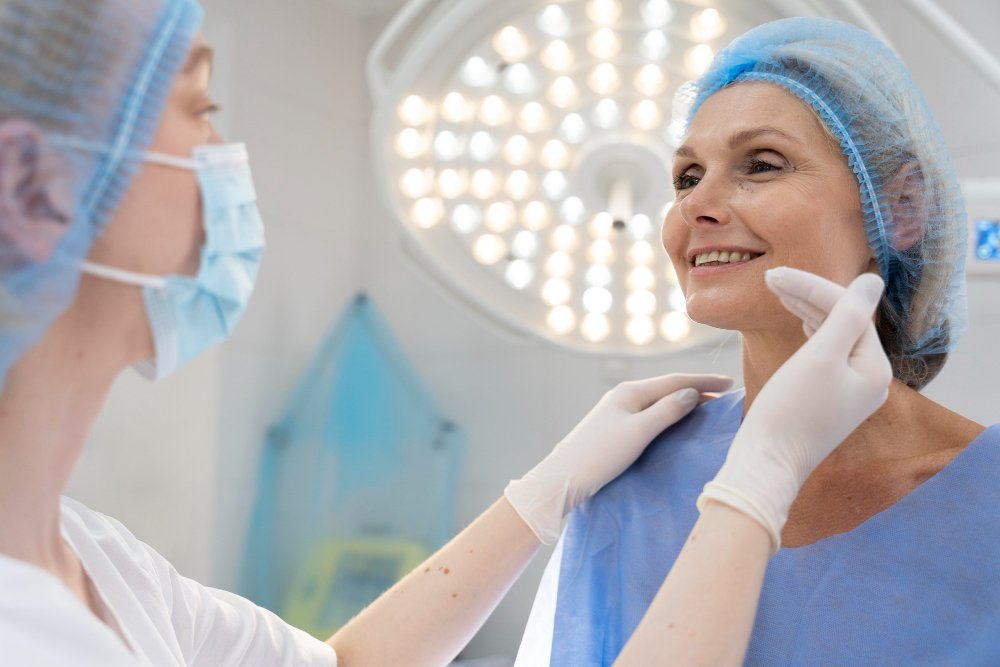
Facial aging is three-dimensional. Skin laxity is only one component: changes also occur in facial fat compartments, retaining ligaments, muscle support, bone relationships and skin quality. A three-dimensional facelift is therefore not a single branded operation. It is a planning concept that combines tissue repositioning, volume assessment and surface treatment according to the patient’s anatomy.
What three-dimensional facial rejuvenation means
A face can look older because tissues have descended, volume has been lost or redistributed, the neck has become less defined, or the skin has changed. Pulling the skin cannot correct all of these factors. Dr. June Favarin evaluates the upper, middle and lower thirds of the face, the eyelid-cheek junction, jawline and neck before defining the scope of surgery.
The plan may include a facelift, neck lift, brow or midface video-assisted surgery, blepharoplasty, facial fat grafting or selected skin treatments. These procedures are not automatically combined. The objective is to treat the structures that contribute to the individual patient’s concerns while preserving facial identity.
Repositioning, volume and skin are different problems
Tissue descent
Facelift techniques reposition deeper tissues and may improve the cheek, jowls, jawline and neck. A Deep Plane approach can be appropriate when ligament release and deeper mobilization are needed, but it is not universally superior. The safest effective plane depends on anatomy, previous treatments, scarring and the areas being addressed.
Volume
Facial fat grafting may be used to restore selected areas such as the temples, upper-eyelid A-frame, lid-cheek junction or perioral region. Microfat provides structural volume; nanofat is used more superficially for selected skin-quality goals and does not create lift. Some grafted fat is reabsorbed during early healing, and the retained amount varies.
Skin quality
Wrinkles, pigmentation, enlarged pores and sun damage are not fully corrected by lifting. CO₂ laser, radiofrequency or other dermatologic treatments may be considered separately when appropriate. Surgery improves signs of aging; it does not eliminate every wrinkle, fold or area of laxity.
Previous injectables can change the plan
Patients should disclose hyaluronic-acid fillers, biostimulators, threads, fat grafting and energy-based treatments. These can alter volume, generate fibrosis or make surgical planes less predictable. Dermatologic ultrasound may be required to map previous materials. Hyaluronidase can modify or degrade hyaluronic-acid filler, but response varies and complete removal cannot be guaranteed. Permanent fillers, particularly liquid silicone, require special caution and may contraindicate surgery.
| Facial Component | What Changes With Age | Typical Approach | Key Limitation |
|---|---|---|---|
| Tissue descent | Cheek, jowl, jawline and neck laxity from ligament and tissue changes | Facelift (Deep Plane or another approach, selected by anatomy) | Plane choice depends on anatomy, scarring and prior treatments — no single approach is universally superior |
| Volume | Loss or redistribution in temples, upper-eyelid area, lid-cheek junction and perioral region | Facial fat grafting (microfat for structure, nanofat for skin quality) | Some grafted fat is reabsorbed during healing; retained amount varies |
| Skin quality | Wrinkles, pigmentation, enlarged pores and sun damage | CO₂ laser, radiofrequency or other dermatologic treatments | Not fully corrected by lifting or repositioning alone |
| Previous injectables | Altered volume, fibrosis, less predictable surgical planes | Ultrasound mapping; hyaluronidase where appropriate | Complete removal cannot be guaranteed; permanent fillers may contraindicate surgery |
What surgery cannot promise
No operation can guarantee symmetry, erase all marionette lines or stop future aging. A good surgical result is different from the complete absence of skin laxity. The degree and duration of improvement depend on the starting anatomy, skin quality, facial volume, healing, lifestyle and procedure performed. Complementary procedures or later refinements may improve selected residual concerns.
Risks and recovery
Potential complications include bleeding or hematoma, infection, fluid collection, delayed healing, unfavorable scars, skin compromise, asymmetry, contour irregularity, altered sensation, temporary or permanent nerve weakness, hairline changes and revision surgery. Risk can be reduced but not eliminated.
Swelling, bruising, tightness, numbness and temporary changes in facial movement are expected early. Recovery differs according to the combination of procedures. Social readiness commonly takes several weeks, while residual swelling, scars and tissue softness continue to evolve for months.
Questions that help clarify treatment scope
- Which of the three problems — tissue descent, volume loss or skin quality — is actually responsible for my concern?
- Is a Deep Plane approach necessary for my anatomy, or would a different plane be safer and equally effective?
- Which areas, if any, would benefit from facial fat grafting rather than repositioning alone?
- Do I need separate skin-quality treatment such as laser or radiofrequency, and can it be done at the same time as surgery?
- Have I disclosed all previous fillers, biostimulators, threads or energy-based treatments that could affect surgical planning?
Frequently Asked Questions
What does “three-dimensional” mean in facial rejuvenation?
It means treating tissue descent, volume changes and skin quality as separate problems that require different solutions, rather than relying on skin tightening alone.
Is a Deep Plane facelift always the right technique?
No. The safest, most effective surgical plane depends on the patient’s anatomy, previous treatments, scarring and the specific areas being addressed — it is not universally superior.
Can surgery fully correct skin quality issues like wrinkles and pigmentation?
No. Surgery improves signs of aging but does not eliminate every wrinkle, fold or area of laxity; dermatologic treatments such as CO₂ laser or radiofrequency may be considered separately for skin quality.
Planning surgery in Brazil
International planning begins with video consultation, standardized photographs, medical history and review of previous treatments. Patients are generally asked to arrive in Criciúma one or two days before surgery and remain in Brazil for at least 15 days. The operation is performed in a hospital, and flying home requires examination and medical clearance.
Belvivere’s concierge service supports local logistics, while the clinical team directs preparation and follow-up. Recovery is not a tourism itinerary: sun, beaches, long excursions and strenuous activities must wait.
Learn more about choosing facelift scope and technique, facial fat grafting and the international patient journey.