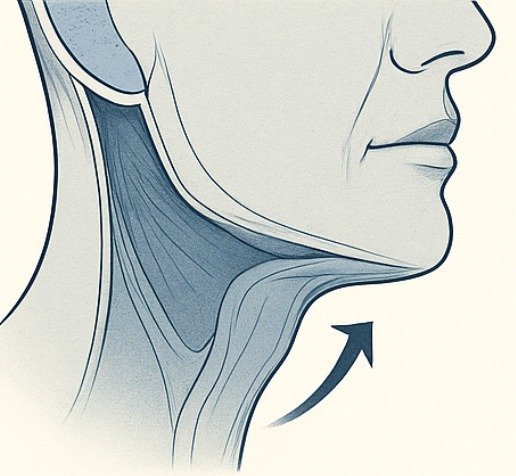
Facial rejuvenation is not one treatment and cannot reverse aging. A useful plan separates tissue descent, volume loss, skin laxity, muscle activity and surface quality. Surgery, fat grafting, injectables and dermatologic treatments solve different problems and should not be used interchangeably.
Match the treatment to the structure
| Concern | What should be assessed | Possible treatment category |
|---|---|---|
| Heavy brow or upper eyelid | Brow position, frontalis activity, skin, ptosis and volume | Video-assisted brow surgery, Hybrid Blepharoplasty or ptosis correction |
| Lower-eyelid bags or hollows | Orbital fat, lid support, cheek, edema and previous filler | Selected eyelid surgery, microfat or dermatologic care |
| Midface flattening | Tissue descent, volume loss, bone support and edema | Repositioning, conservative volume or no procedure |
| Jowls | SMAS, ligaments, fat and skeletal support | Selected facelift approach |
| Neck fullness or bands | Skin, fat, platysma, deep structures and chin support | Liposuction, Neck Lift, Deep Neck or no surgery |
| Texture or pigmentation | Epidermis and dermis | Dermatologic treatment rather than lifting surgery |
What surgery can—and cannot—change
A facelift repositions selected deeper tissues and redrapes skin; it does not erase pores, pigmentation or every wrinkle. Deep Plane is one option for selected lower-face anatomy. Video-assisted surgery is usually directed to the brow and selected midface descent. Hybrid Blepharoplasty addresses only the eyelid and periorbital components supported by examination. Neck Lift and Deep Neck treat different cervical layers.
No technique is universally superior. Learn why Deep Plane and video-assisted surgery have different goals.
When volume is appropriate
Adding volume can help a true deficit but does not reliably lift descended tissue. Microfat is used for selected structural restoration; nanofat has different superficial applications and is not a structural filler. Retention varies, and asymmetry, irregularity or the need for refinement are possible. Rapid weight loss, including GLP-1-associated change, can alter the plan.
Skin treatments are a separate dimension
Lasers, radiofrequency, ultrasound and other devices may improve selected aspects of texture, pigment or mild laxity. They do not release facial ligaments or reproduce a surgical lift. Aggressive treatment around thin eyelid skin, previous permanent products or compromised tissue requires particular caution.
Previous procedures can change the anatomy
Fillers, biostimulators, threads, PMMA, silicone, surgery and energy treatments should be documented. Dermatologic ultrasound may be appropriate when product type, location or tissue response is uncertain. Hyaluronidase applies to hyaluronic-acid filler only and does not guarantee complete reversal. See how injectables influence surgical planning.
Preserving identity and function
Natural-looking treatment depends on individualized vectors, conservative skin tension, appropriate volume and respect for facial movement. More elevation, filling or tissue removal is not automatically better. No procedure can guarantee symmetry, emotional transformation or a fixed duration.
Safety, recovery and international care
Candidacy includes medical history, eye health, nicotine, nutrition, weight stability, thrombosis risk and anesthesia assessment. Major facial surgery is performed at Hospital São José. Recovery can include swelling, bruising, numbness, tightness, fatigue and temporary asymmetry.
International patients generally plan at least 15 days in Brazil after major procedures. Belvivere’s concierge service supports accommodation and local transport, while clinical decisions and travel clearance remain with the medical team.