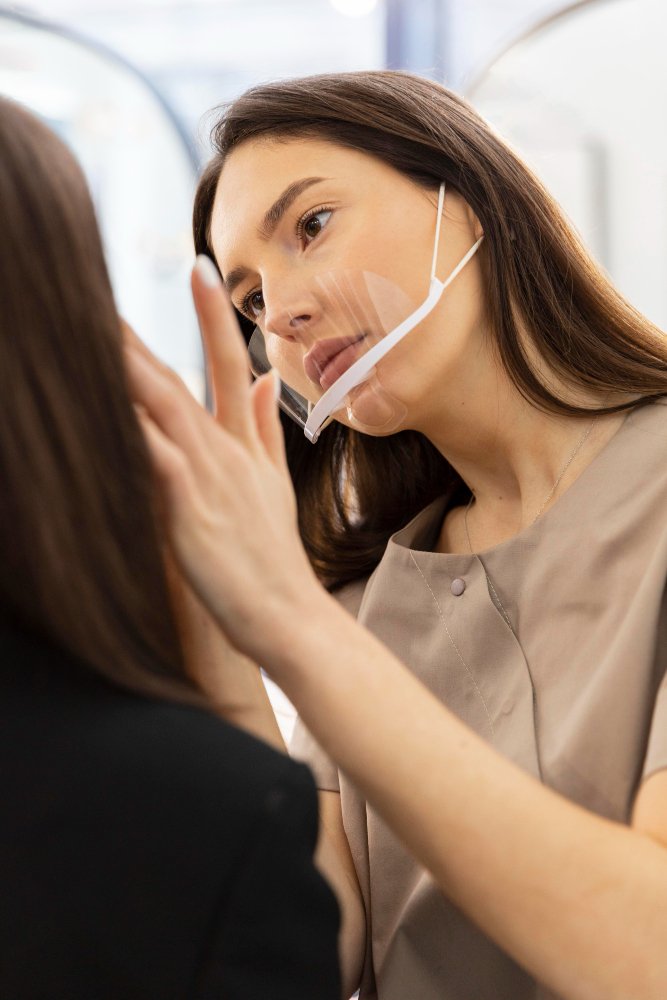
Lower blepharoplasty should be planned around eyelid function, support and the transition between the lower eyelid and cheek. Under-eye “bags” can reflect prominent orbital fat, but a tired appearance may also result from hollowing, skin laxity, cheek descent, malar edema, festoons or previous filler. These findings are not interchangeable.
What is causing the under-eye concern?
| Finding | What it may require |
|---|---|
| Prominent fat compartments | Selective preservation, reduction or repositioning through an appropriate surgical approach |
| Skin laxity | Conservative skin treatment or excision when safe |
| Tear-trough hollowing | Volume assessment; microfat may be considered in selected patients |
| Lower-eyelid laxity | Support such as canthopexy when indicated |
| Midface descent | Separate evaluation for tissue repositioning rather than automatic volume addition |
| Malar edema or festoons | Specific diagnosis; blepharoplasty alone may not correct the problem |
Dr. June’s lower-eyelid approach
Within Dr. June Favarin’s Hybrid Blepharoplasty concept, the lower eyelid is treated conservatively and in context. When appropriate, the orbital fat is approached transconjunctivally, from inside the eyelid. Her bi-incisional internal approach allows selective access to the three fat compartments without an external incision for that portion of surgery.
The objective is not to empty the orbit. Excessive fat or skin removal can produce hollowing, retraction, difficulty closing the eye or a change in expression. Fat may be preserved, selectively reduced or repositioned according to anatomy. Lower-eyelid support and the ocular surface are assessed before deciding whether canthopexy or another measure is appropriate.
Microfat, nanofat and midface surgery are different tools
Microfat may restore small areas of structural volume loss, such as the lid-cheek transition. Nanofat is more finely processed and may be used selectively for superficial skin-quality indications; it is not a lifting procedure or a substitute for structural volume.
If the cheek has descended, adding volume does not necessarily correct tissue position. Video-assisted midface surgery may be considered in selected patients, but it is not routinely added to lower blepharoplasty. The least extensive plan that addresses the cause is generally preferred.
Previous fillers and dermatologic ultrasound
Old fillers can contribute to swelling, contour irregularity or diagnostic uncertainty. Patients should disclose all injectables, threads, energy treatments and previous operations. Dermatologic ultrasound may help map residual material or altered planes. Hyaluronidase may be useful for hyaluronic acid in selected cases, but it does not treat PMMA, silicone, biostimulators, fat or every cause of edema.
Risks and limits
Potential complications include bleeding, infection, prolonged swelling, chemosis, dry-eye symptoms, asymmetry, visible scarring, lower-eyelid malposition, difficulty closing the eyes, sensory change and revision surgery. Double vision and vision-threatening bleeding are uncommon but require urgent assessment. Pre-existing dry eye, thyroid eye disease, eyelid laxity or prior surgery may require ophthalmologic evaluation or a modified plan.
Recovery and international planning
Swelling often increases during the first 48–72 hours, and bruising varies. Many patients feel more comfortable socially after one to two weeks, but residual edema and scar maturation continue for longer. Combined brow or midface surgery extends recovery.
International patients begin with remote assessment and complete the diagnosis in person. Surgery is performed at Hospital São José. The concierge team assists with logistics, while the medical team determines follow-up and fitness to fly. Learn more on the Hybrid Blepharoplasty page.
This article is educational and does not replace an individualized medical evaluation.