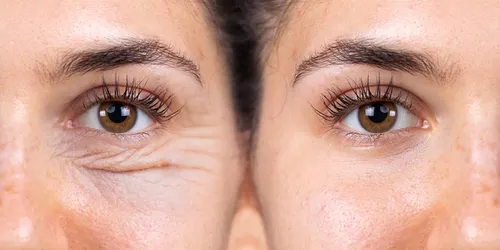
Old under-eye filler can affect blepharoplasty planning even when the patient believes it has already disappeared. The important questions are what was injected, where it is located, whether it contributes to edema or distortion, and how it changes the diagnosis. The objective is to understand the current anatomy—not to remove every previous treatment automatically.
Why the injection record matters
Hyaluronic-acid filler may persist longer than expected and attract water in thin periorbital tissues. Biostimulators, PMMA, silicone and fat grafts behave differently and are not dissolved by hyaluronidase. Threads, previous surgery and energy-based procedures may also create fibrosis or altered planes.
Patients should provide product names, dates, quantities, injection areas, photographs and records of swelling, nodules, infection or previous dissolution whenever available.
| Finding | Possible next step | What should not be assumed |
|---|---|---|
| Clear anatomy without symptoms | Observation may be appropriate | Every old filler requires dissolution |
| Persistent lower-lid or malar edema | Examination and possible ultrasound | All swelling is caused by filler |
| Hyaluronic acid distorting the surgical plan | Selective hyaluronidase may be discussed | One session guarantees complete removal |
| Unknown or permanent product | Imaging and individualized risk assessment | Hyaluronidase can remove non-HA products |
What dermatologic ultrasound adds
High-frequency ultrasound may help locate residual product, estimate its plane and distribution, and identify edema or inflammatory changes. It is especially useful when the history is incomplete or the examination does not match the reported treatment. Imaging supports clinical judgment but cannot always identify the exact product or determine surgical eligibility by itself.
Read more about ultrasound before hyaluronidase treatment.
How previous filler changes eyelid diagnosis
Apparent “bags” may reflect orbital fat, filler, edema, festoons or a combination. A hollow may be genuine or revealed after filler dissolution. Brow descent, true eyelid ptosis, lid support and ocular-surface health must also be assessed. Treating only the most visible contour can lead to an incomplete or inappropriate plan.
Hybrid Blepharoplasty is component-based
Dr. June Favarin’s Hybrid Blepharoplasty may include conservative upper-eyelid skin treatment with orbicularis preservation, transconjunctival lower-eyelid surgery, selective cantopexy, microfat, nanofat or a skin-directed treatment. No component is automatic. Prior filler does not dictate one operation, but unrecognized material can increase diagnostic uncertainty and prolong swelling.
See the indications and limits of Hybrid Blepharoplasty.
Timing, risks and international planning
There is no universal interval between dissolution and surgery. Inflammation and contour should stabilize enough for a reliable examination. Blepharoplasty still carries risks including bleeding, dry eye, chemosis, infection, asymmetry, lid malposition and revision.
International patients should allow time for imaging, selective treatment, reassessment and postoperative reviews rather than scheduling dissolution, surgery and return travel together. Major combined procedures are performed at Hospital São José. Belvivere’s concierge team supports accommodation and transport while timing remains a medical decision.