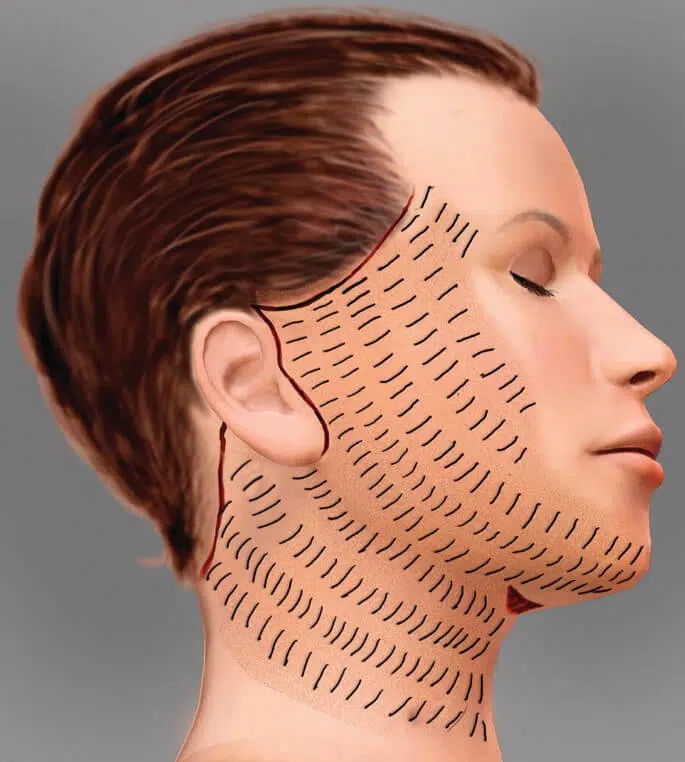
A hemostatic net is a pattern of temporary transcutaneous sutures used in selected facelift and other flap procedures. The sutures bring elevated tissue into contact with the underlying bed, limit shear and may assist with hemostasis and dead-space control. It is a surgical tool—not a guarantee against hematoma, seroma, bruising or skin complications.
What the net is designed to do
| Goal | Potential contribution | Limitation |
|---|---|---|
| Hemostasis | Provides broad, gentle compression over selected areas | Does not replace careful vessel control |
| Dead-space control | Approximates the flap to the tissue bed | Fluid collections can still occur |
| Flap stabilization | Reduces movement between tissue planes | Excess pressure can injure skin |
| Drain strategy | May support a drain-free protocol in selected cases | Drains may still be appropriate in other operations |
Hemostatic net versus drains
The two methods are not exact substitutes. A drain removes fluid that reaches the tube; a hemostatic net compresses and stabilizes tissue. Procedure type, dissection extent, bleeding risk, surgeon technique and patient factors determine whether a net, drains, both or neither are used. “Drain-free” should not be marketed as inherently safer or more comfortable for everyone.
What patients see after surgery
The net produces a temporary grid of sutures and skin dimpling. Bruising and swelling remain possible. Removal timing varies with the protocol and clinical findings. Small puncture marks, irritation, blistering, pressure injury, infection, pigmentation change or temporary contour marks can occur. Patients need clear instructions not to manipulate the sutures.
Hematoma remains an emergency concern
A hemostatic net does not eliminate the possibility of postoperative bleeding. Rapid one-sided swelling, increasing pain, firmness, drainage, breathing difficulty or a sudden change in facial contour requires urgent contact with the surgical team. Early assessment protects the skin flap and overall recovery.
How it fits into facelift safety
Bleeding control also depends on medical preparation, blood-pressure management, medication review, meticulous intraoperative hemostasis and postoperative monitoring. Nicotine, anticoagulants, supplements and uncontrolled hypertension can increase risk. The operative plan should balance tissue repositioning with perfusion and avoid excessive skin tension.
See the guides to facelift recovery and warning signs and facelift neurological safety.
Hospital and international-patient planning
Belvivere plans major facial procedures in a hospital with anesthesia monitoring and early postoperative review. International patients should remain near the team while bleeding risk and swelling are most dynamic; major facial procedures commonly require at least 15 days in Brazil, adjusted individually. The concierge service supports accommodation and practical logistics.
The appropriate tool depends on the case
A hemostatic net can be useful within a broader safety strategy, but its value depends on correct indication and execution. Patients should understand why it is being proposed, how it will look, when it will be removed and which warning signs require immediate assessment.