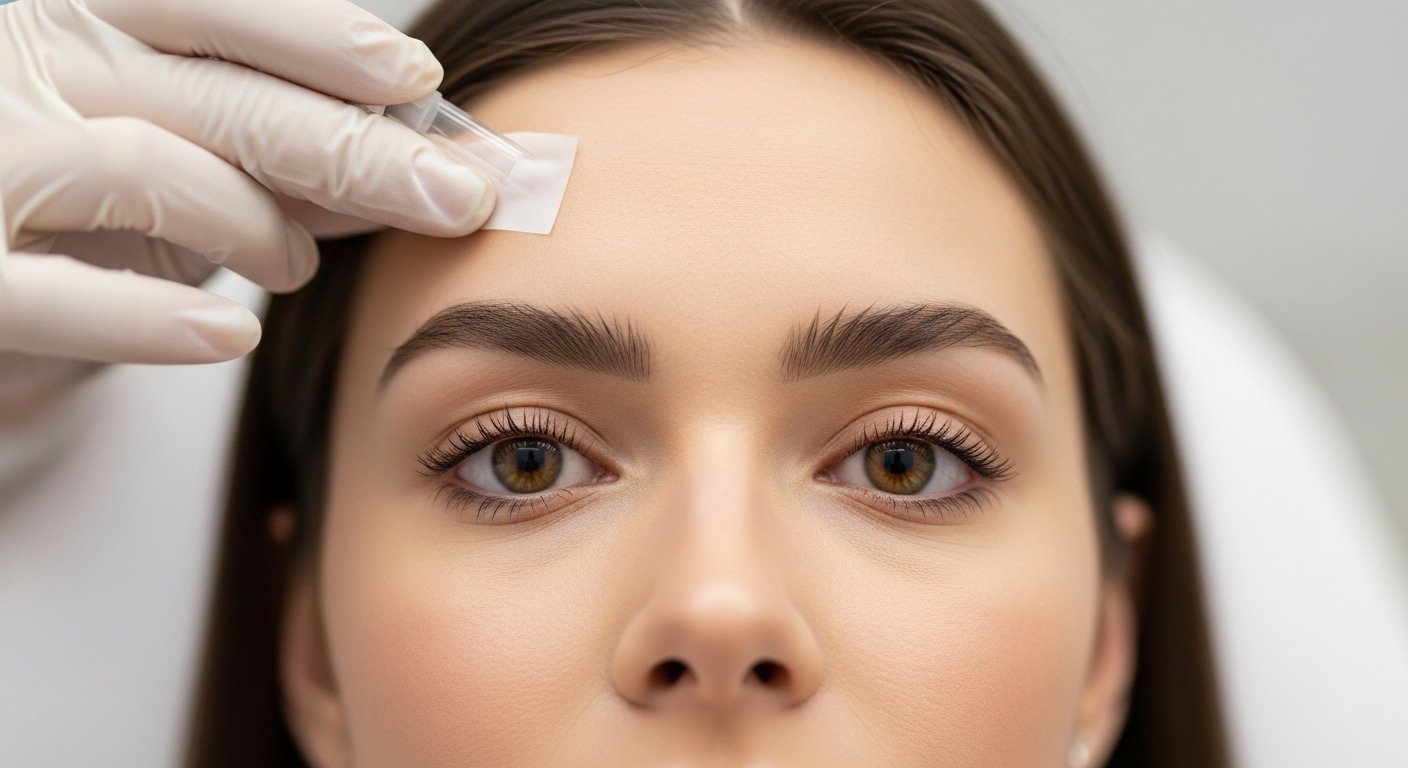
Why Can the Eyebrow Drop After Botox or Eyelid Surgery?
Many patients seek medical advice after noticing an unexpected change following Botox injections or eyelid surgery (blepharoplasty): the eyebrow appears lower, the eyes look heavier, and in some cases, the eyelids seem swollen or worse than before. Although this can be alarming, this outcome is often not due to a technical error, but rather to a specific muscular condition known as a hyperdynamic frontalis muscle.
Understanding this mechanism is essential to choosing the correct treatment and achieving natural, satisfying results.
The Role of the Frontalis Muscle and Eyebrow Balance
The position of the eyebrow is not determined solely by bone structure. It is maintained by a delicate muscular balance between muscles that elevate the eyebrow and those that pull it downward.
The frontalis muscle, located in the forehead, is responsible for lifting the eyebrows. On the other hand, muscles such as the orbicularis oculi, which forms crow’s feet, and the corrugator muscle, which pulls the eyebrow downward and inward, act in the opposite direction.
This balance becomes evident in daily situations. For example, when squinting against bright sunlight, contraction of the orbicularis muscle causes the eyebrows to descend.
What Is a Hyperdynamic Frontalis Muscle?
Some patients—especially those with excess upper eyelid skin—develop an unconscious compensatory mechanism. To keep their eyes open, they constantly contract the frontalis muscle, artificially elevating the eyebrows.
This condition is called a hyperdynamic frontalis muscle, meaning the muscle remains chronically activated to compensate for eyelid skin redundancy. Over time, patients become accustomed to this elevated brow position and perceive it as their normal appearance.
What Happens When Botox Is Applied?
Botox works by relaxing the targeted muscle. When injected into the forehead of patients with a hyperdynamic frontalis muscle, it stops this compensatory contraction. As a result, the eyebrow returns to its true anatomical position, which is lower than the previously compensated position.
This leads to common complaints such as:
- A sensation that the eyes are more closed
- A feeling of eyelid heaviness or swelling
- The impression that Botox made the appearance worse
In reality, the Botox simply removed the muscular compensation that was masking the underlying eyelid excess.
For this reason, patients with a hyperdynamic frontalis muscle are often poor candidates for isolated forehead Botox.
Why Can the Same Thing Happen After Eyelid Surgery?
A similar effect may occur after blepharoplasty. Once excess eyelid skin is removed, the patient no longer needs to contract the frontalis muscle to keep the eyes open. The muscle relaxes naturally, and the eyebrows descend.
This can create the false impression that the surgery failed, when in fact the eyebrow position has simply returned to its natural resting state.
Why Is Proper Evaluation So Important?
If this muscular compensation is not identified before treatment, patients may feel disappointed or dissatisfied, believing that Botox or surgery worsened their appearance.
A thorough pre-procedure evaluation of eyebrow position at rest and muscle activity is crucial to selecting the most appropriate treatment strategy.
What Is the Best Solution for These Patients?
The solution is not to avoid treatment, but to choose the correct approach. Many patients with a hyperdynamic frontalis muscle benefit from combined procedures, such as:
- Brow lift
- Forehead lift
- Blepharoplasty combined with brow elevation
Younger patients may respond very well to a forehead or brow lift alone. Older patients, however, often require a combination of brow elevation and excess eyelid skin removal to achieve balanced, natural results.
The Importance of Fat Grafting Around the Eyes
Another key factor in achieving a natural outcome is fat grafting. After eyelid surgery, especially in fair-skinned patients, hollowing of the upper eyelid and periorbital region is common.
Without proper volume restoration, the eyes may appear sunken, tired, or even skeletal. Fat grafting helps restore volume, smooth transitions, and create a more youthful, harmonious appearance.
Differences Between Male and Female Eyebrows
Special attention is required when treating male patients. Male eyebrows are typically flatter, and most men do not want an arched appearance. The goal is subtle elevation while maintaining a straight, masculine brow shape.
Conclusion
When properly indicated, both Botox and eyelid surgery can deliver excellent results. The key lies in understanding frontalis muscle behavior, identifying compensatory mechanisms, and tailoring the treatment plan to each individual patient.
With accurate evaluation and the right combination of procedures, it is possible to avoid a heavy or tired appearance and achieve a natural, balanced facial rejuvenation.